React Native is an open-source mobile application framework developed by Facebook, designed for building native mobile applications using JavaScript and React. Introduced in 2015, React Native allows developers to create cross-platform mobile apps that run on both iOS and Android platforms while sharing a single codebase. Key features of React Native include: 1. Single Codebase:Continue reading “React Native – Explained In 200 Words”
Category Archives: Framework
SASS – Explained In 200 Words
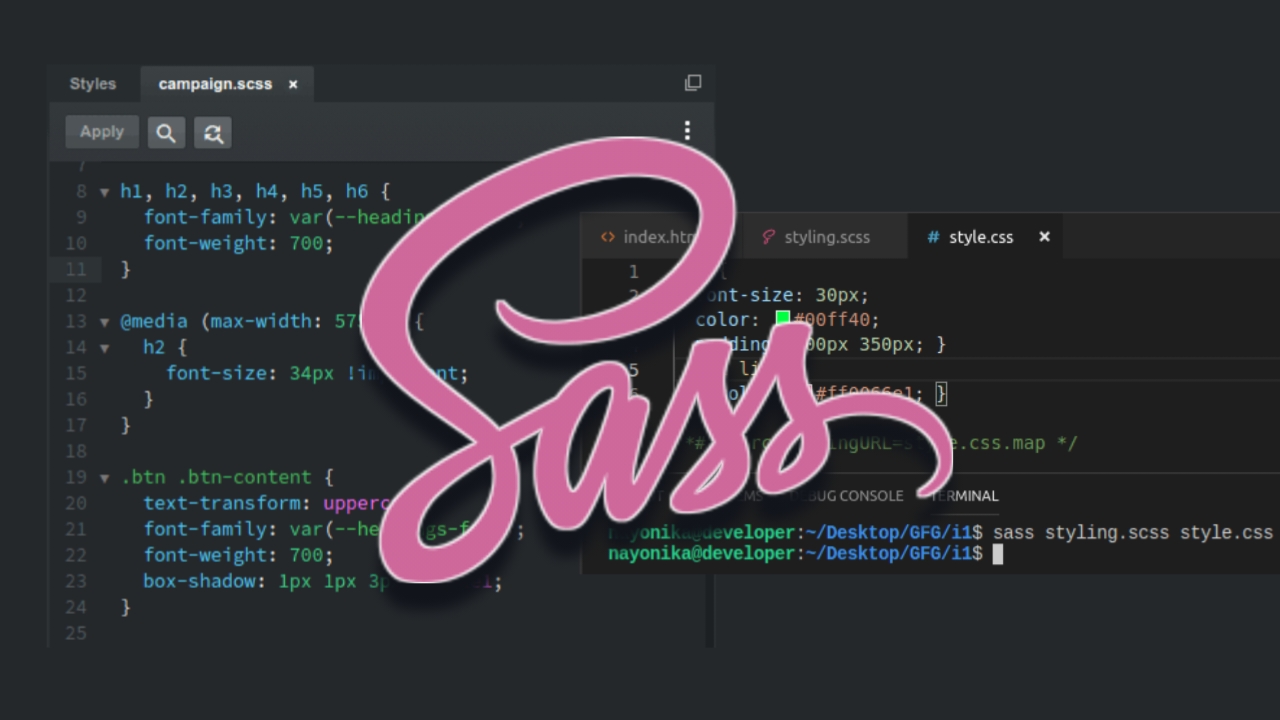
Sass, an evolution of CSS, emerged in 2006 as a preprocessor scripting language to address CSS limitations. Initially conceptualized by Hampton Catlin and later refined by Natalie Weizenbaum, Sass introduced advanced features like variables, nesting, mixins, and inheritance. For instance, Sass variables enable defining reusable values, such as colors or font sizes, enhancing maintainability: $primary-color:Continue reading “SASS – Explained In 200 Words”
Next.js – Explained In 200 Words
Next.js is a popular open-source React framework for building server-side rendered (SSR) or statically generated web applications. Developed by Vercel, it simplifies the development of React applications by providing a pre-configured setup with features like server-side rendering, client-side routing, and automatic code splitting. Key features of Next.js include: 1. Server-Side Rendering (SSR): Next.js enables developersContinue reading “Next.js – Explained In 200 Words”
Angular – Explained In 200 Words

Angular is a popular open-source web application framework developed by Google. It was first released in 2010 as AngularJS and later rewritten in TypeScript to become Angular 2+ in 2016. Angular is widely used for building dynamic, single-page web applications (SPAs) and large-scale enterprise applications. Angular follows the model-view-controller (MVC) architecture, where the application logic,Continue reading “Angular – Explained In 200 Words”
React – Explained In 200 Words
React is a popular JavaScript library for building user interfaces, developed by Facebook in 2013. It is widely used for creating interactive and dynamic web applications with high performance and scalability. React follows a component-based architecture, where UIs are composed of reusable and independent components. Each component manages its own state and renders a partContinue reading “React – Explained In 200 Words”
Nmap – Explained In 200 Words

Nmap, short for Network Mapper, is a free and open-source network scanning tool used for discovering hosts and services on a computer network and evaluating their security posture. Developed by Gordon Lyon in 1997, Nmap has become one of the most widely used network exploration and security auditing tools. Nmap utilizes raw IP packets toContinue reading “Nmap – Explained In 200 Words”
Vue.js – Explained In 200 Words

Vue.js is a progressive JavaScript framework used for building user interfaces and single-page applications. Created by Evan You in 2014, Vue.js has gained popularity for its simplicity, flexibility, and ease of integration with existing projects. Vue.js is known for its reactive data binding, allowing developers to declaratively bind data to the DOM (Document Object Model)Continue reading “Vue.js – Explained In 200 Words”
Bootstrap – Explained In 200 Words
Bootstrap is a popular front-end framework for building responsive and mobile-first websites and web applications. Developed by Twitter in 2011, Bootstrap provides a collection of HTML, CSS, and JavaScript components and utilities that simplify the process of designing and styling user interfaces. One of Bootstrap’s key features is its grid system, which allows developers toContinue reading “Bootstrap – Explained In 200 Words”
NodeJS – Explained In 200 Words
Node.js is a powerful, server-side JavaScript runtime environment that allows developers to build scalable and efficient network applications. Developed by Ryan Dahl in 2009, Node.js is built on Chrome’s V8 JavaScript engine and operates on a non-blocking, event-driven architecture, making it lightweight and efficient for handling concurrent connections and I/O operations. Node.js enables developers toContinue reading “NodeJS – Explained In 200 Words”
PHP – Explained In 200 Words
PHP is a server-side scripting language primarily used for web development. Created by Danish-Canadian programmer Rasmus Lerdorf in 1994, PHP originally stood for “Personal Home Page,” but now it stands for “Hypertext Preprocessor.” PHP’s simplicity and ease of integration with HTML make it popular for building dynamic websites and web applications. PHP is embedded directlyContinue reading “PHP – Explained In 200 Words”
 Byronic